For friends in automation, robotics and mechanical design · 2026.10.13
Make hillside bin handling less of a chore.
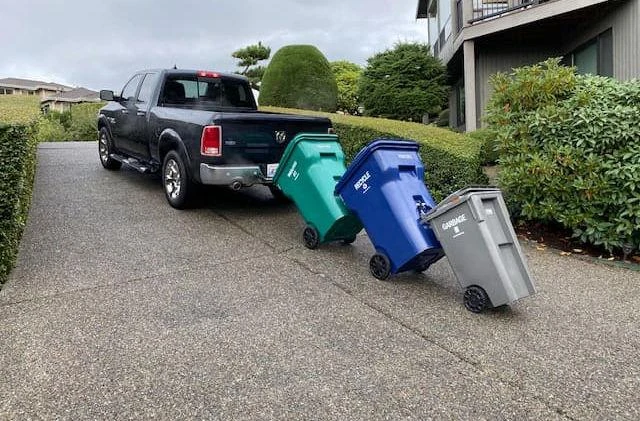
Three bins travel down and back up a hillside every week. Four households also share a crowded collection point with about twelve bins. Could an existing powered platform, thoughtful fixtures and limited automation make the whole job easier?
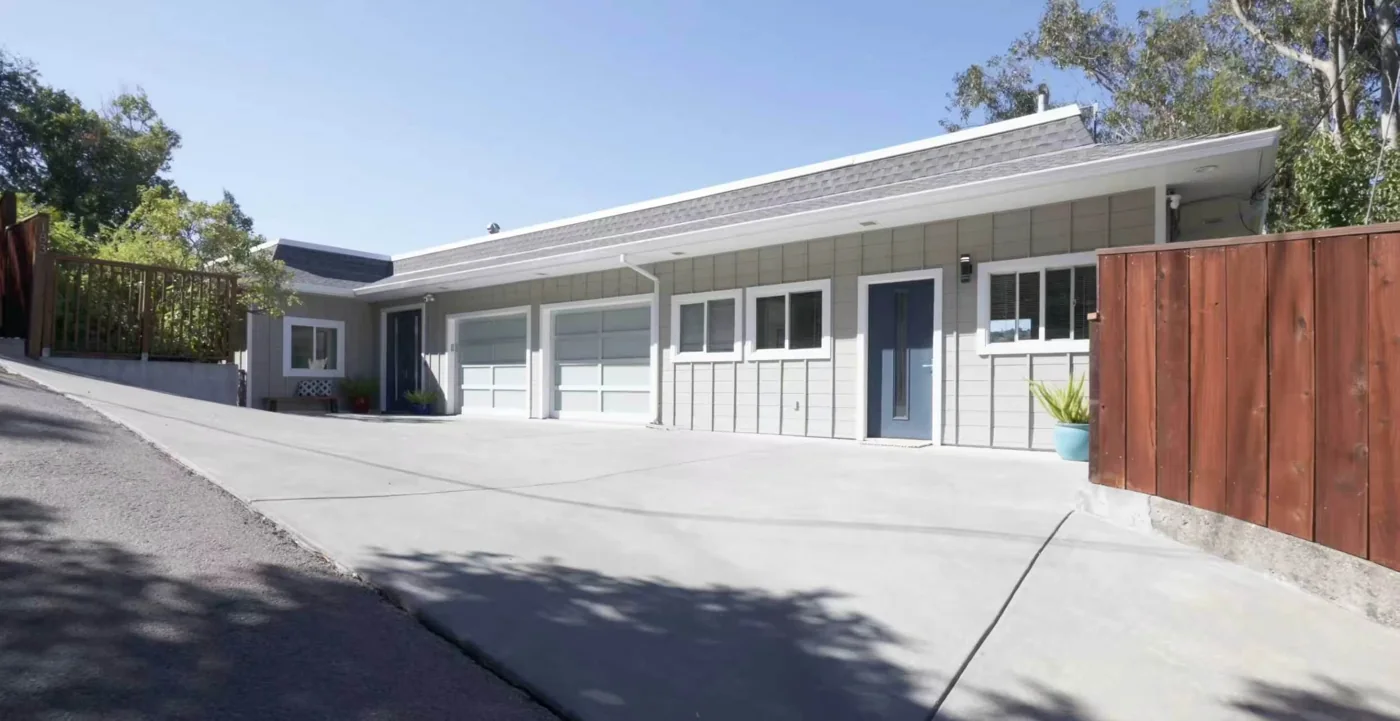
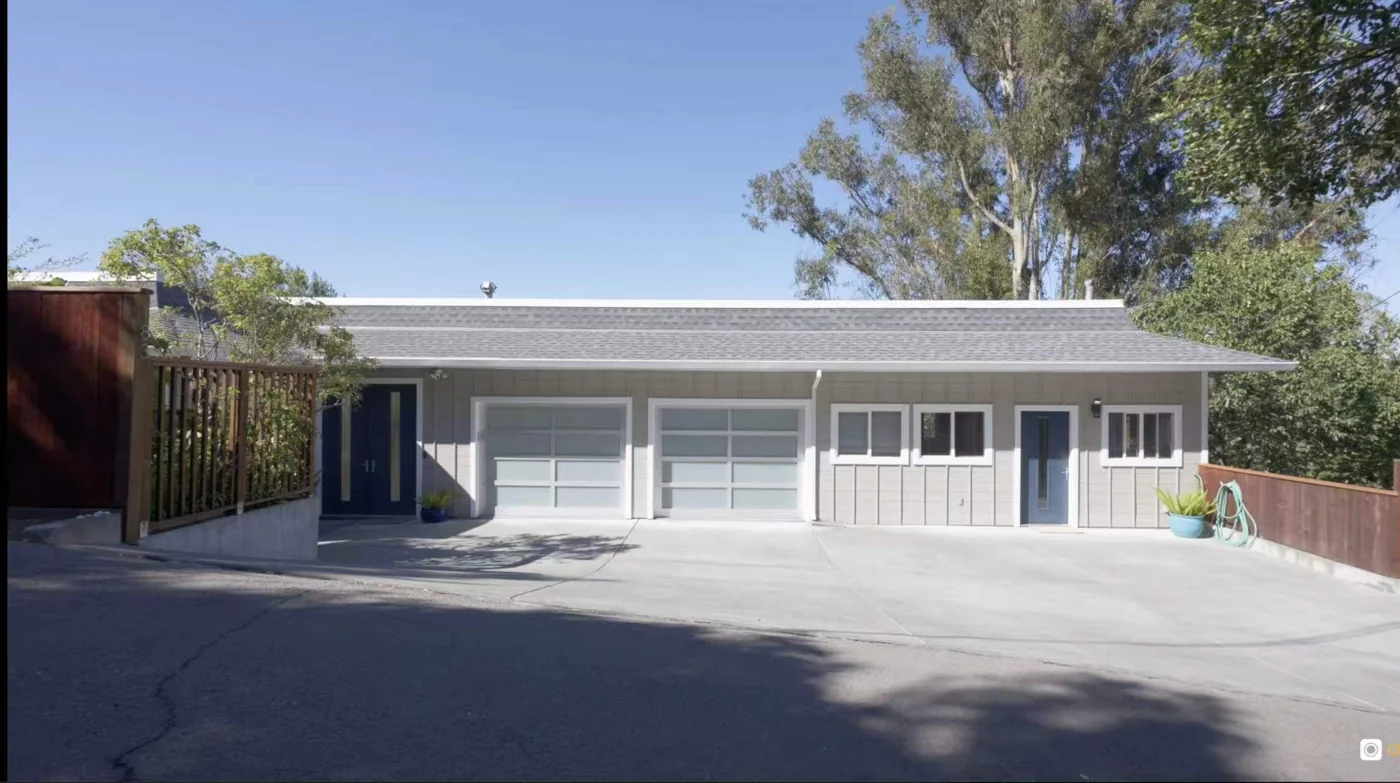
The actual driveway, looking uphill Photo date unknown. Route measurements still need verification.
01 / The problem and intended outcome
Less effort, fewer steps, controlled downhill movement.
At my Marin hillside home, bins are stored on the deck outside the kitchen. Taking them out means a narrow passage, a parking-area turn, a small uphill section and crest, then downhill curves. The bins must come back afterwards. I am looking for a permanent household tool, and would appreciate an independent engineering judgment before committing to a design.
A / Transport for one household
Home → collection point → home
One powered device handles our three bins. Compare sequential single-bin trips with moving several together. Start with a person present, low-speed assistance and reliable stopping; fixed-route autonomy is a later option.
B / The shared collection point
Store → present → return
Four households share about twelve mixed-size bins. Compare a button-indexed carousel with fixed numbered storage and single-bin transfer. Keep the original bay empty and locked while the truck is emptying its bin.
At homeEasy engagement→TransportSpeed, brakes, yielding→HandoffSecure before release→CollectionIndependent lift & return
These are separate problems. A collection station does not replace uphill transport. Future unattended operation on a shared driveway must handle vehicles, obstacles, a safe waiting position and manual recovery.
35.8–36.2 in91–92 cm pinch point, owner measurement
18° / 32.5%Transport design target, not a surveyed maximum
12° / 21.3%Phone reading at collection / release area
3 bins / ~256 ftAbout 78 m total route, owner report
Existing 96 US gal bin width: about 27.6 in / 70 cm. Gate: about 37.4 in / 95 cm. Proposed complete loaded width: 28.3–29.5 in / 72–75 cm, not a verified clearance. Full-bin mass, center of gravity, cross-slope, turns, crests and station footprint remain unknown. I intend to replace our two 96 gal bins with 64 gal; this has not happened and neighbors' bins are not standardized.
02 / Options to compare
Existing ideas to learn from. No validated design for this route yet.
Transport A
A short single-bin carrier
Benefit: a low support or tilting mount can reduce lifting effort and keep the vehicle short.
Must demonstrate: loaded 18° controlled descent, stopping, power-loss holding, wet-road traction, stability and easy release at the reported 12° endpoint.
Tradeoffs: a long platform adds crest clearance and rollover concerns; a train adds reverse steering, coordinated braking and jackknife risks. The suggested 7.2 ft × 27.6 in platform with a 15 in / 38 cm deck height has no verified stability envelope.
Benefit: present the selected waste stream at one pickup position.
Tradeoffs: the all-64-gal circular example needs about a 15 ft / 4.6 m rotating envelope, before truck gripper clearance. Leveling, eccentric loads, locks and safe return are major issues.
Benefit: rail guidance or a rack drive could cover the hardest incline. The owner envisages a twenty-plus-meter segment; its length is unmeasured.
Boundary: stop within the red segment, do not extend onto the neighbor's driveway, preserve drainage and route around the lemon tree. Prefer one carrier that changes drive mode over transferring bins.
A rail can help on the incline. Both ends still matter.
The owner's red segment follows the privacy-fence side of the slope. The blue segment is the lower portion of the owner's driveway; beyond it lies a neighbor's driveway. Only the red segment is being considered for fixed rails. A gravel strip carries rainwater and contains plants. A lemon tree requires a detour; bends, endpoints and property boundaries need field confirmation.
Red: fixed assistanceIndependent support / tree / drainage→Blue: owner's drivewayContinue on ground wheels→Neighbor's drivewayNo fixed rails proposed here→Shared collectionStable stopping and release
Abstract diagram from the owner's annotation, not a survey, scale map or permission to build. The twenty-plus-meter length is a concept estimate.
Transition 1
Separate rail cart with transfers
May simplify components, but can add stopping, securing, hooking and reloading at both ends. Measure total task time, remaining manual hauling and return work.
Transition 2
The same carrier, two drive modes
Concept: keep the bins on one wheeled carrier, engage controlled guidance or positive drive on the red segment, disengage at a secured endpoint and continue on wheels. Mode transitions, anti-runback, loss-of-power holding and non-rail operation need validation.
Do not assume a single side rail supports every load or prevents rollover. Design rail/wheel load sharing, an independent foundation, bends, lateral forces and drainage clearance. The wooden privacy fence is not a proven structural support. Max Maker's rack-drive upgrade is an inspiration, not proof for this route. Rack upgrade at 5:57 ↗
03 / Market and price: facts versus assumptions
A possible residential niche. Paid demand is not validated.
Start with homes where repeated bin handling on a long or sloped route is inconvenient, existing workarounds are inadequate and owners value reduced effort. The model under consideration is household equipment with site adaptation: separately price the platform, fixture, installation, commissioning and support.
68,523 unitsMarin detached housing stock DOF estimate, January 1, 2026
$149,091Median household income Census 2020–2024, 2024 dollars
UnmeasuredHillside share, actual pain, deployability and willingness to pay
The DOF total includes vacant and rental units. It is neither a count of hillside mansions nor buyers or annual sales. Income is county background, not the target segment's income. DOF dataset ↗ · Census QuickFacts ↗
What fraction of detached homes is on hillsides?
This research has not found a published countywide housing count or share. Public data exists to calculate a defined estimate. Marin County provides parcel/address data; MarinMap provides ground DEM and a Slope service. Overlay the housing inventory with terrain, rather than applying the county's sloping-land area percentage to housing units.
Detached stock→Hillside homes GIS analysis pending→Actual bin route Distance and grade→Deployable buyers Site and demand tests
One analysis could report sensitivity at natural grades ≥10%, ≥20% and ≥30%, separating parcel-average terrain, surroundings of the building and actual driveways. These are analysis thresholds, not a single legal definition. Verify raster units, missing values, housing classification, coverage date and multi-dwelling parcels. Match numerator and denominator: parcel counts cannot simply be divided by DOF dwelling-unit counts.
A hillside home does not automatically mean difficult bin handling. Standard curbside service involves presenting bins, but bins may already sit near the road, a driveway may be flat or an owner may have vehicle assistance. Mill Valley Refuse documents hills, narrow streets and manual collection; qualifying elderly or disabled customers may arrange property collection. Terrain, handling difficulty and willingness to buy are different measures.
Sources exist; the countywide overlay has not been performed. Hillside housing share remains unknown. The 5%, 10% and 15% below are assumed pain incidence, not measured hillside proportions.
Illustrative buyer scenarios — not a forecast
For a household transport tool at an assumed US$4,000–6,000 installed price, with reliable safety and service. The shared twelve-bin station is a different installation product; these counts do not apply to it.
68,523 × assumed pain incidence × deployable fraction × purchase fraction. All three fractions are unmeasured.
Case
Pain
Deployable
Purchase
Illustrative buyer stock
Low
5%
50%
15%
~260
Middle
10%
60%
25%
~1,030
High
15%
70%
35%
~2,520
The wide range reflects uncertainty, not measured market size. At the middle assumptions, reaching 20% of buyers over five years would mean only about 41 sales a year. This is also unvalidated. Marin could be a pilot location; current evidence does not establish a large standalone business.
Test a price, not a claim
US$4,000–6,000 is an interview hypothesis, not a supplier quote or customer commitment. Determine US delivery, commissioning, support and failure costs. Station foundations and shared maintenance are separate.
Measure net time saved
Example assumptions: save 15 minutes a week, or 13 hours a year; pay $4,000 upfront plus $200 annual upkeep. Five-year cost is $5,000, about $77 per hour saved. This is not cash income; hookup, unloading and faults reduce the benefit.
Get evidence before scaling
A later pilot could interview 10–20 households and measure several real routes. Compare existing assistance and tools, repeated use, willingness to pay and maintenance. A shared station also requires agreement over space, cost and responsibility.
No further manufacturer, neighbor, municipal or hauler outreach has been made for this update.
04 / What I would like your help with
Help choose the direction. No complete engineering package yet.
Architecture
Which concept should be tested first?
Separate transport from collection-station handling. Identify likely failure modes, usable platforms and genuinely custom parts.
Minimum prototype
What is the smallest useful test?
A sketch, component list, missing measurements and controlled loaded-bin / handoff tests. Keep total user effort in view.
Commercial judgment
Can cost and support fit the value?
Estimate development, unit delivery, site adaptation and maintenance. Decide whether this fits small-batch integration or possible standardization.
05 / Source references — expand as needed
Real projects to learn from.
The first three links are original creators' YouTube videos. These demonstrate prior work, not 18° loaded performance, safe 12° release or compatibility with this shared driveway.
Twelve-bin collection station: indexed carouselInteractive handoff, footprints and slope foundationExpand
Shared endpoint / concept only
One waste stream. One bin at a time.
Four households, about twelve mixed 32 / 64 / 96 US gal bins. A button could index the chosen stream to one pickup window. Keep the station locked while its bin is being emptied and returned. Presence sensing alone must not trigger advancement.
Interactive illustration / no hardware connection
Choose a stream, then try a pickup cycle.
This illustration assumes one trash, one recycling and one organics bin per household. Actual inventory is unconfirmed; colors are diagram keys, not local bin colors. The circle uses an all-64-gal reference envelope, not today's mixed inventory.
Selecting a stream only changes the filter. Confirm the area is clear and press an index button to move.
Current pickup bayHousehold A · TrashBay locked · awaiting confirmation
Confirm the area is clear first. The bay stays locked; there is no timed automatic movement.
Index & lockConfirm the requested position.
Truck lifts binKeep its original bay empty.
Return to that bayVerify stable placement and clearance.
Confirm next cycleFinish this stream before changing.
A state illustration, not a safety controller. Real position/lock feedback, independent safety detection, misplacement handling, E-stop and power-loss holding require engineering. Gripper symbols are not a swept-path or clearance model.
Footprint assumptions
A rotating circle is not automatically compact.
The MSS 2021 commercial / multifamily guide gives a 64 gal example envelope of 26 in wide × 29 in deep (0.6604 × 0.7366 m). This is not today's bins or a guarantee for replacement carts. Calculations assume 0.10 m gaps and 0.10 m outer allowance, not approved gripper clearance. Original guide ↗
01 / Twelve radial bays
Radial carousel
Example diameter 4.6 m; circle area 16.5 m². Add guarding, maintenance and actual pickup space.
02 / Two rows of six, back-to-back
Compact when stationary
Bins plus assumed gaps: 4.5 × 1.6 m. Rotating all twelve needs ~4.73 m / 15.5 ft diagonal clearance, before structure. Back-row access and orientation still matter.
03 / Fixed bays, one transfer
Move only the required bin
Compare a short guided transfer to one pickup window. It reduces moving mass, but back-row access, mixed bin types, return and pinch points remain unresolved. No footprint or quote is established.
Geometry behind the example
w = 0.6604 m; d = 0.7366 m; g = 0.10 m; e = 0.10 m. For twelve bins each confined to a 30° sector: inner radius r = (w + g) / [2 tan(15°)]. Envelope D = 2√[(r + d)² + ((w + g)/2)²] + 2e ≈ 4.58 m. This is one non-overlapping layout, not an optimized minimum or structural diameter.
Two rows: L = 6w + 5g ≈ 4.46 m; B = 2d + g ≈ 1.57 m; rotating rectangle diagonal √(L²+B²) ≈ 4.73 m. The rectangle excludes outer allowances, frame and access aisles.
Slope and foundation
No gravity-fed free movement.
Study a near-level support surface, controlled indexing, positive locking and loss-of-power holding. Do not use the truck's lifting force as the carousel drive.
If a 4.58 m diameter happens to align with a 12° slope, ground elevation changes by about 0.97 m / 3.2 ft: D × tan(12°). This is a geometric example, not an actual foundation section. Slope direction and location are unmeasured. Compare leveling, smaller mechanisms or fixed bays; confirm pickup heights, drainage and foundation capacity.
Six questions for the station designer
Does it fit without occupying the shared road?
Can each bin be independently lifted?
How are indexing, locking and holding separated?
What happens when a bin is missing or returned crooked?
How are category and household identity preserved?
What low-speed, supervised prototype can validate the handoff?
No municipal or hauler contact is being initiated. Published commercial enclosure guidance is background, not a confirmed residential approval. Full loads, eccentric loading, outdoor exposure, safe reach, guards and manual recovery remain design inputs.
The manufacturer's waste-room systems support up to five bins with 240 / 660 / 1100 L options. Automatic full-to-empty switching in a building is not proof of twelve mixed outdoor bins being lifted and returned by a road collection truck.
DIY projects, historical products and original sourcesWhat is demonstrated, what is still unknownExpand
Max Maker · 2022.12.27
Trash Train
A powered locomotive and bin platforms move on a fixed track. Arduino's project account describes insufficient grip / power with a wiper motor and rubber wheel, followed by a rack-and-pinion upgrade and endpoint charging.
Useful for mechanical guidance and repeatable endpoints. Track installation on a shared driveway and this route's 18° loaded braking remain unverified.
An actual self-driving bin prototype and public code, including garbage-truck model training and Jetson / Raspberry Pi runtime instructions. Detecting a truck does not establish collision avoidance, slope holding or safe lift compatibility.
The author describes a design by his brother that travels out on collection days and returns home. No verified loaded slope, power-loss holding or shared-driveway performance is established.
Gizmodo's September 30, 2019 X post shows the curb-delivery concept. NERC's May 22, 2024 description concerns weighing and waste data. These are not evidence of a currently purchasable autonomous hillside transporter.
Useful tilt, coupling and pin references. The company's instructions prohibit backing up with bins attached. That is a direct mismatch with the desired uphill-side powered head reversing downhill.
Creator pages, descriptions and chapters were checked; videos are not treated as full engineering tests. X live search required login, so the historical public post was used. Public code is a research reference, not a validated safety controller or a confirmed commercial license.
Route, field inputs and public elevation screeningOwner reports, photos and missing measurementsExpand
Operating intent and constraints
For a tow arrangement on the main incline, keep the powered head uphill: reverse downhill while restraining the bin load, pull forward uphill. Small uphill sections, crests, braking and turns change connection loads; all conditions need review. A rigid carrier avoids some tow joints but still needs traction, clearance and rollover checks.
Reported full route: about 256 ft / 78 m. A 111 ft / 33.8 m subsection has unconfirmed endpoints. Phone readings were confirmed as degrees: 15° = 26.8%, 18° = 32.5%, 20° = 36.4%, 22° = 40.4%. The 18° transport design target is not a surveyed route maximum. The 12° endpoint reading lacks a recorded longitudinal / transverse direction. Extreme 20–22° spots have not been fully excluded from the swept path.
Parking / turn area. Photos cannot establish longitudinal or cross-slope.Another view of the transition area; exact stopping and maneuvering lines remain to be marked.
Public GIS is screening, not pavement verification
A curved ground-DEM candidate is retained at about 246 ft / 75.1 m, with 1 m samples and 2 / 5 / 10 m windows. Its start is not the deck. A deck surface, narrow-passage tie-in, tree-covered pavement, walls and local raised areas remain unresolved. Project-wide vertical accuracy is not local road accuracy. No surveyed maximum or reliable cross-slope is claimed.
The county 2018–2019 LiDAR product report describes a delivered 1.5 US survey ft / ~0.46 m DEM. The service uses EPSG:2872 HARN; the delivery report's reference differs and requires verification. Ground-classified LAS / LAZ and local pavement returns have not been independently checked.
Required-route steepest longitudinal grade and endpoint longitudinal / cross-slope.
Full bin mass and center of gravity, complete loaded width and lowest clearance.
Both wheel paths through turns, gate / hose bracket clearances and crest transitions.
Exact stopping, independent bin securement and release position.
Rail endpoints, drainage, lemon-tree detour and collection station width / depth.
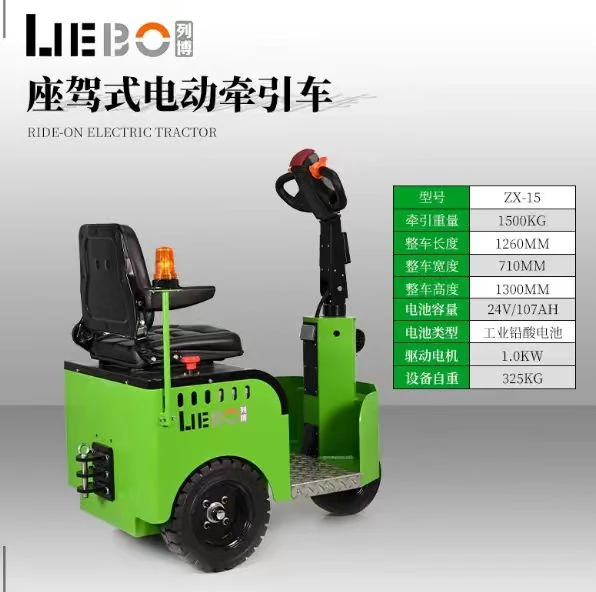
Review normal descent, stopping distance, heat buildup, power-loss holding and full-battery limits on regeneration. A stated climbing capacity or electromagnetic parking brake does not establish the whole system's downhill safety. Secure the whole vehicle, independently support / stop the bin, then release it; do not ask a person to catch a rolling loaded bin.
Product and fixture image referencesOriginal-wheel coupling, powered carriers and componentsExpand
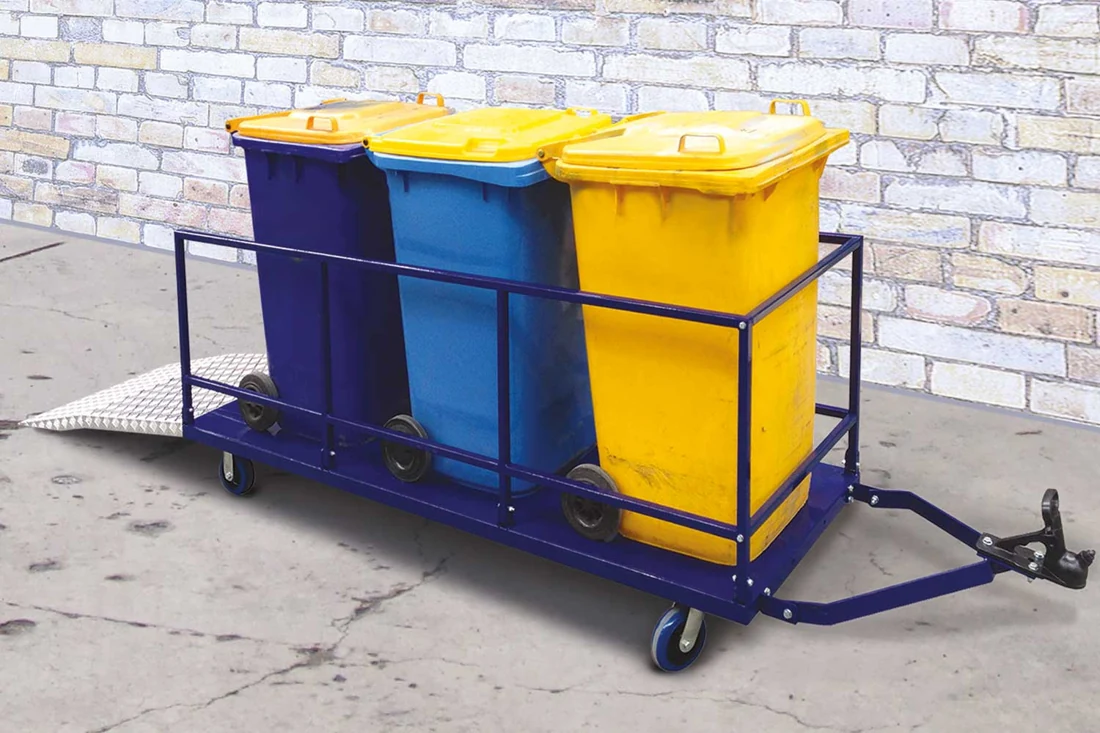
Images below are references, not purchase recommendations or proof of this route's rated performance. Owner-provided advertisements retain their original language. The existing three-bin 3D carrier is a kinematic concept; wheel directions are idealized rather than dynamically controlled.
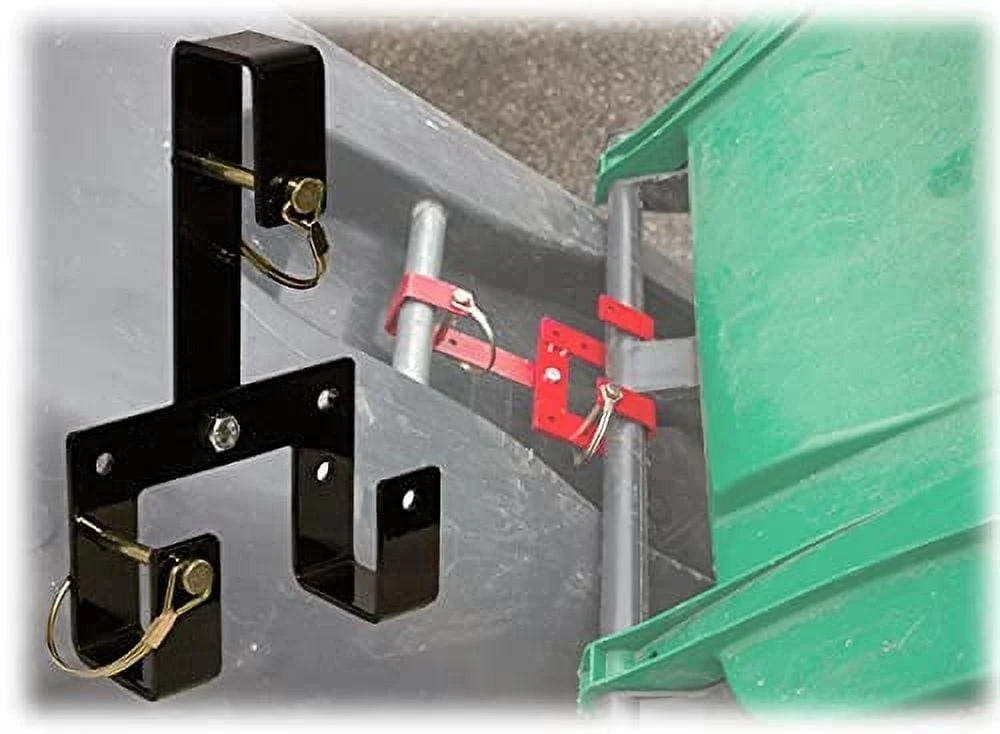
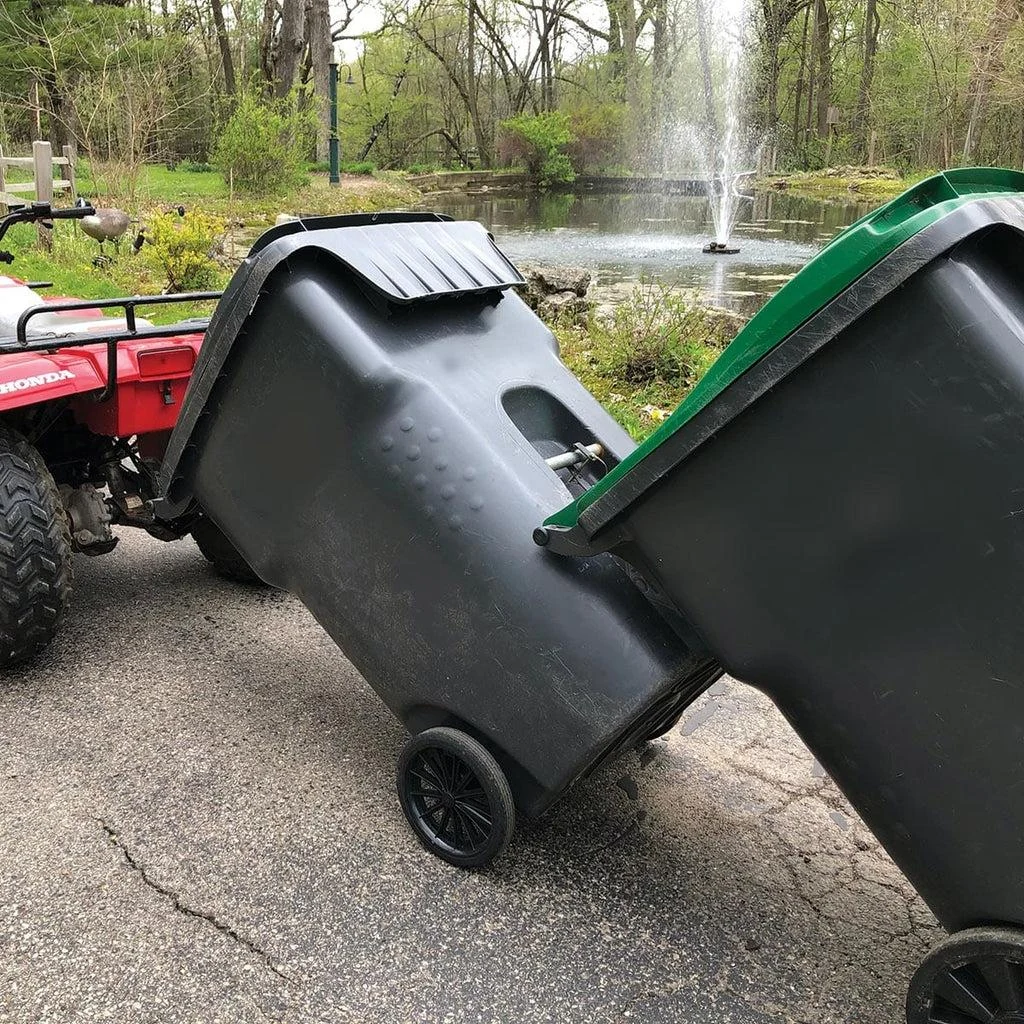
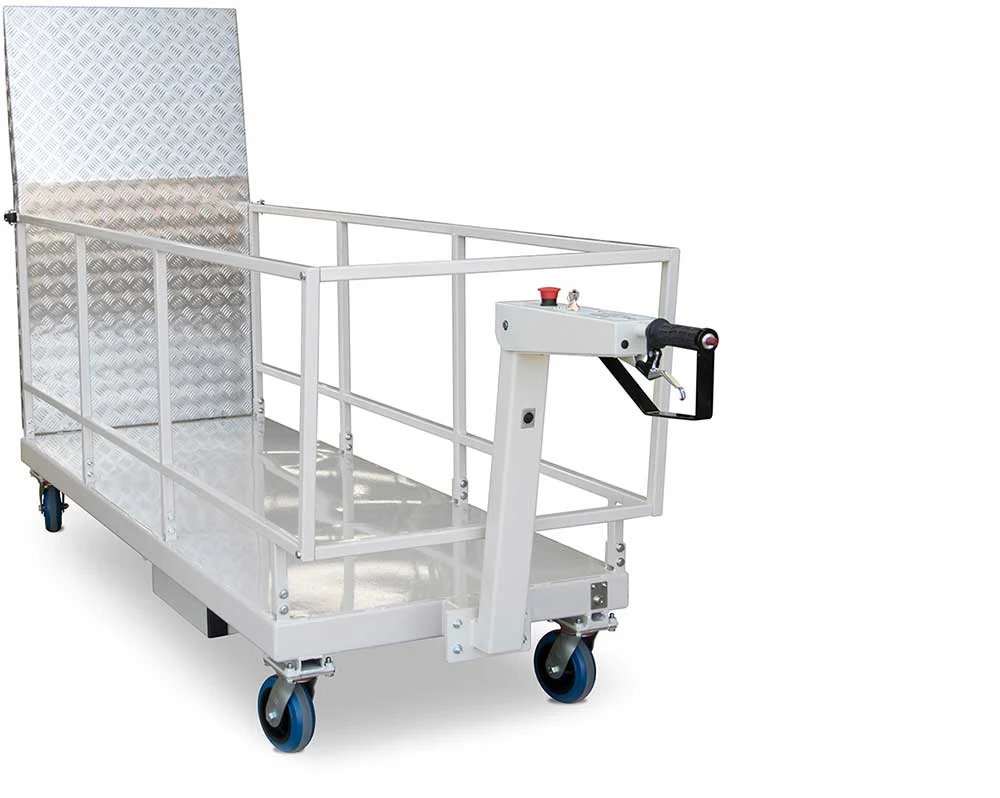
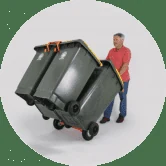
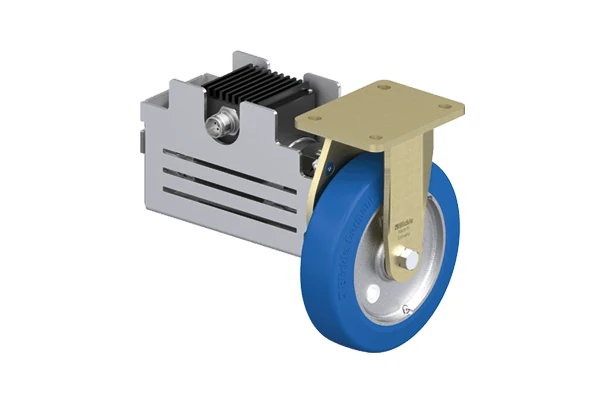
Original wheels and tilted bins. Can Coupler reference ↗Pin, hook and anti-detachment details to study. No verified reverse downhill performance.A first-bin tilt mount. Coupler force, axle loads, bin-handle capacity and tipping remain to be evaluated.ZX-15 advertisement: 1,500 kg nominal traction, 710 mm width, 325 kg machine weight. Advertised towing mass is not an 18° loaded downhill rating.Electrodrive powered bin trolley ↗ — study handling and support geometry.WheelieSafe electric trolley ↗ — engagement and ergonomic reference.Electrodrive bin-mover application ↗ — carrier architecture reference.ErgoMove powered-wheel system ↗ — component reference, not a complete outdoor safety solution.
A 1,200 mm fork, low front rollers, an outdoor-grip claim or a “slope brake” advertisement does not by itself solve three-bin packaging, curved pavement, braking attachment loads or unload effort.
Thanks for helping choose the direction.
Facts, owner reports, concepts and unknowns are kept distinct. The intended outcome is a tool that reduces the whole chore, with clear limits on sites it can serve.